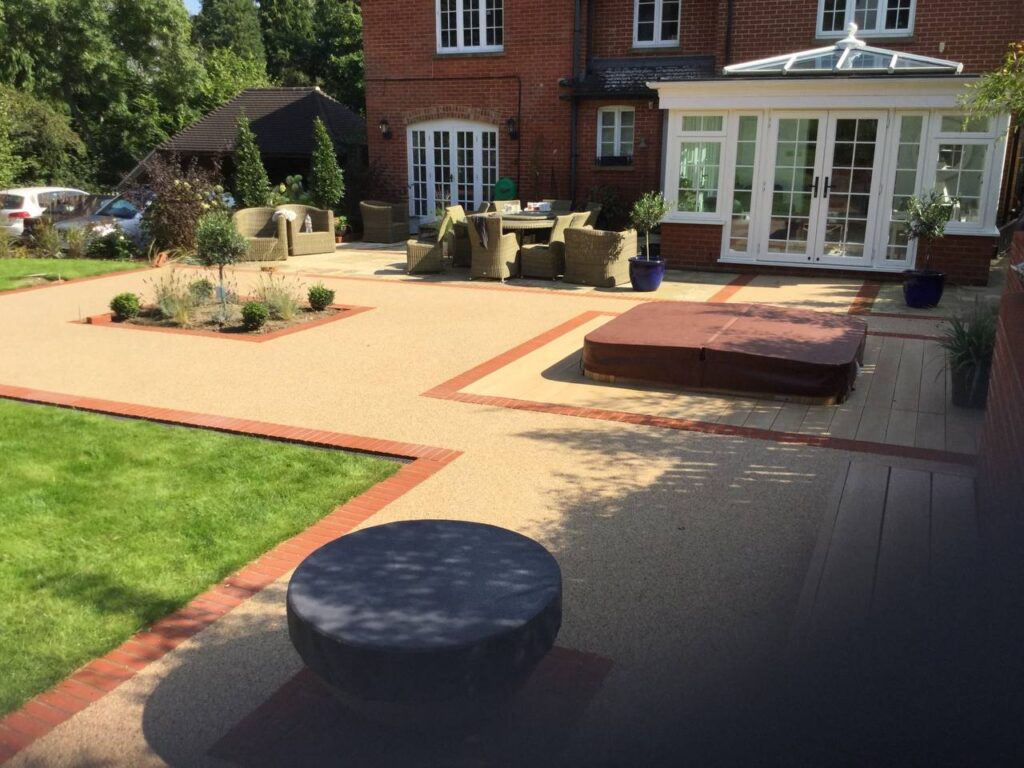
What Are the Benefits of Resin-Bound Surfacing for Outdoor Seating Areas?
An outdoor seating area should provide a comfortable and practical place for dining, relaxing and entertaining. Its surface needs to support furniture securely, cope with regular foot traffic and complement the surrounding property.
Resin-bound surfacing can meet these requirements while offering considerable flexibility in colour, texture and layout. For property owners in Egham, Surrey, it can provide a smooth and attractive alternative to conventional paving when installed over a correctly prepared base.
Why Resin-Bound Surfacing Works Well for Seating Areas
A resin-bound surface is created by mixing selected aggregates with a clear resin before applying the material evenly to the prepared area. Because every stone is coated and held within the mixture, the finished surface is firm, seamless and free from loose aggregate.
Its suitability depends on the quality of the preparation as much as the visible finish. A stable base, suitable drainage and careful installation are essential if the completed seating area is to perform well over time.
A Smooth Surface for Garden Furniture
Tables and chairs work best on a surface that is level and consistent. Uneven paving, wide joints or loose gravel can cause furniture legs to rock, sink or become difficult to reposition.
Resin-bound surfacing creates a continuous finish with no individual slabs to settle independently. This helps provide stable support for dining furniture, benches, plant containers and other outdoor features.
The smoother finish can also make it easier to move chairs without catching their legs in joints or loose material.
Comfortable and Accessible Movement
Outdoor seating areas often need to accommodate regular movement between the house, garden and surrounding paths. A seamless resin-bound surface can provide a clear and comfortable route without abrupt joints or uneven changes in level.
This is particularly useful when carrying food and drinks, moving garden furniture or using wheeled equipment. Gentle transitions can also be incorporated between connected areas where the layout and levels allow.
Careful planning remains important, as accessibility depends on the complete design rather than the surface material alone.
A Permeable Surface Can Support Drainage
Standing water can make an outdoor seating area less comfortable to use and contribute to surface deterioration. Resin-bound surfacing has an open structure that allows water to pass through the finished layer.
For the installation to function as a permeable system, it must be laid over a suitable base that also allows water to drain correctly. Applying resin-bound material over an unsuitable or poorly draining foundation will not resolve an underlying drainage problem.
A professional site assessment should establish the existing falls, ground conditions and drainage requirements before work begins.
No Loose Stones Around the Seating Area
Loose gravel can move beneath furniture, spread into adjoining areas and become trapped in footwear. It may also need frequent redistribution where chairs and tables are used regularly.
The aggregate in a resin-bound surface is fixed within the resin mixture. This provides the appearance and texture of natural stone without loose material migrating around the garden.
Some surface texture remains, helping the area avoid the completely flat appearance of a plain hard surface.
Flexible Design Options
Resin-bound aggregates are available in a variety of natural-looking colours and stone blends. This makes it possible to select a finish that works with the property, planting and other garden materials.
Different colours can also be used to define the seating area or create a clear border. Curves, pathways and connecting sections can be incorporated into the layout without relying solely on straight lines.
A restrained design usually produces the most coherent result. The surface should complement the wider outdoor space rather than appear disconnected from it.
Easier Routine Maintenance
A seamless surface has fewer joints in which weeds and debris can collect. Leaves and loose dirt can normally be removed through regular sweeping, helping the seating area remain tidy.
Any spills should be addressed promptly using an appropriate cleaning method. Furniture feet should also be kept in good condition so sharp or damaged edges do not place unnecessary pressure on the surface.
Although resin-bound surfacing is relatively straightforward to maintain, occasional cleaning and sensible care are still required.
Suitable for Connecting Seating Areas with Paths
A seating space is more useful when it links naturally with the rest of the garden. Resin-bound surfacing can continue from a patio-style area into pathways, creating a consistent transition between different outdoor zones.
This can help make the layout feel more spacious and organised. It may also reduce awkward changes between materials where chairs, serving trolleys or garden equipment need to pass.
The complete route should be considered during the planning stage so that levels, edging and drainage work together.
Strong Edging Helps Maintain the Finish
Resin-bound material needs secure, accurately installed edges. These contain the surface, define its shape and create a neat transition to lawns, borders or other paving materials.
Weak or poorly positioned edging can affect the appearance of the finished area and leave margins vulnerable to damage. The edging design should therefore be selected before the resin-bound surface is installed.
Preparation Determines Long-Term Performance
A high-quality finish cannot compensate for an unstable foundation. Cracked, moving or poorly drained bases may allow defects to affect the new surface.
Before installation, the area should be assessed for:
- Ground stability
- Existing cracks or movement
- Surface levels and falls
- Drainage performance
- Suitable edging
- Required access and intended use
- The condition of any existing base
Professional preparation ensures that the design is based on the actual site conditions rather than appearance alone.
Is Resin-Bound Surfacing Right for Every Seating Area?
Resin-bound surfacing is a strong option for many outdoor seating areas, but it is not automatically suitable for every site. The condition of the base, drainage requirements, surrounding levels and intended use must all be considered.
Where the existing foundation is unsuitable, further preparation may be required before the finish can be installed correctly. An assessment will clarify whether the area is appropriate and how it should be constructed.
Conclusion
Resin-bound surfacing can create a smooth, stable and visually cohesive outdoor seating area. Its seamless finish supports furniture effectively, simplifies routine maintenance and can provide useful drainage benefits when installed as part of a correctly designed permeable system.
NS Driveways Egham provides professional resin-bound surfacing in Egham, Surrey. If you are planning a new outdoor seating area, contact our team to arrange an assessment and discuss a surface designed around your garden and intended use.
Call us on: 01784 774 591
Click here to find out more about NS Driveways Egham
Click here to complete our contact form and see how we can help with your driveway needs.